Showing posts with label nature. Show all posts

Tuesday, 2 February 2016

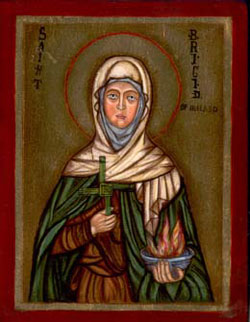
Saint Brigid and the goddess Brigit: how are they related to each other and to Imbolc?

As Pagans and Catholics around the world celebrate Imbolc, Imbolg or Candlemas at this time of year, I thought I would share some information on where this festival, timed perfectly between the Winter Solstice and Spring Equinox, comes from, and why it is so associated with a mysterious figure best known as Brigit.


Are Saint Brigid and the goddess Brigit the same person?

Brigit is a Celtic fire goddess (her name literally means "bright one") who was adopted as a saint by the Catholic Church, making it unlikely that she ever existed as an actual human. The only biographies about her that exist were written hundreds of years after her supposed death in Ireland in the C6th, although she is also credited as having been Jesus' midwife over 500 years earlier. However, legends persist, such as of her miraculous abilities to heal lepers and the blind, turn bathwater into beer and make cows produce three times the normal amount of milk.

As the bringer of fire, Brigit is naturally associated with the first stirrings of the warmer weather of Spring. Imbolc literally means "ewe's milk" and you might be able to sense the first stirrings of fertility trickling back into the land, especially if you live in the countryside. Today was the first day the rescue hens that live near me started laying eggs, for example, after a long Winter break.

This association with the approaching Spring logically leads to Brigit being a goddess of fertility and birth, as well as fire. One of the many variations of her name, Bride (pronounced "breed"), is also the traditional word for a young, fertile woman about to get married and start having children (especially if she happens to be a Catholic). As previously mentioned, Brigid is also a midwife, a sensible job for a fertility goddess and healer.


Why celebrate Imbolc?

Imbolc is a traditional time of year for thinking about health, fertility and the oncoming Spring. For me, it always feels like the true start of the year, a perfect time for making New Year's resolutions, especially ones pertaining to eating better, going to the gym more often or improving mental health. Burn up those bad habits in Brigit's fire!

As with everything to do with making magick work for you, if you can't use it, discard it. You do not need to celebrate any of the Pagan festivals in order to be an occultist or work magick. And if you do choose to mark some or all of them, you can do it however and whenever you like.

Having said that, there are some reasonably traditional ideas that could get you started with celebrating Imbolc or Candlemas. If they don't appeal, don't bother with them- this blog is about a very real and personal path of evolving power, and not a place for conformity!


  1. As a fire goddess, Brigit is about (positive) destruction, which makes way for new life. A Spring clean of one's home/ office/ car and a healthy "detox" of one's body are appropriate, as is a roaring log fire.
  2. As the goddess of Imbolc ("ewe's milk") and also the saint who could turn water into beer, unpasteurised dairy products and dark ale are traditionally served at Brigid's festival. Oat or hazelnut milk would be good vegan options, as both oats and hazelnuts were plentiful in Ancient Ireland. Add a quality probiotic capsule to get the same brain-gut connection benefits as with unpasteurised dairy.
  3. Notice what new flowers are appearing in your local area and look them up on Wikipedia. Imagine how their biological attributes could have spiritual symbolism.
  4. Candles are a fool-proof aid for meditation and ritual, and Candlemas is a traditional time to make your own and light a few.
  5. If you have a fireplace in your home, this is a traditional place to make an altar for Brigit. If not, a bunch of candles somewhere that feels right will work. Red and white are traditional colours associated with the season, perhaps representing snow and fire, ewe's birthing blood on the snow, virginity and menstruation, purity and courage, or whatever you like.
  6. Having sex (maybe near your altar), either alone or in company, would be the perfect way to honour a fertility goddess, and can be conveniently tied in with a Chaos Magick ritual (free download of Ultraculture's simple guide to 'hex sex' here).


Further information

Candlemas is 1 February and Imbolc is traditionally celebrated 1 - 2 February every year, with Celtic Pagans celebrating on the nearest New Moon. This year, that will be Monday 8 February.

Check out Candlemas: Feast of Flames (2001) by Amber and Azrael Arynn K for an informative and reasonably priced Wiccan perspective, as well as some "recipes" for little Wiccan Imbolc rituals, if you're into that sort of thing ;)

If you can get to Glastonbury, England, there is a Pagan temple at the White Spring dedicated to the goddess Brigid that you can visit. Entry is free and it is open until 4.30pm most days. Bring an empty bottle to sample some of the calcium-rich waters.

Saturday, 31 October 2015

Samhain at the Chalice Well Gardens

The Chalice Well Gardens in Glastonbury, England is a famous site visited by all kinds of important occult writers, like Dion Fortune and W. E. Butler. The gardens are laid around the ancient Red Spring, so-called because of its iron content, that has been in constant use since Neolithic times.

Historically, the spring has been characterised as masculine by Christians, with the red colour symbolising the blood of Christ eternally pouring forth, and as feminine by Pagans, with the colour representing menstruation and therefore life. Whatever its "gender", it represents eternal life, and it's great to fill up a few glass bottles with it while you're visiting. A pint every week is a useful iron supplement.


My partner and I just enjoyed an absolutely magical evening there. The gardens were lit entirely with tiny candles, tucked away in all kinds of bushes, around springs and in trees, with the pools of water reflecting the stars and the stars seemingly reflecting all the tiny lights on the ground. As above, so below! It was utterly beautiful. A harpist played gentle music and a group meditation was held.


After the meditation, I had a strong urge to stand in a certain spot by one of the two ancient Yew trees- it was as if I could see an empty person-shaped aura where I should go and stand- so I stood and pressed my hands and forehead against the bark for a while. All I could see behind my eyelids was a beautiful sky-blue. I went and found my boyfriend and asked him to stand in the same spot and see if he could 'see' a colour. He also reported blue. Neither of have us any idea what that could mean- maybe it's the blue the branches reach up to in the daytime?- but it was pretty cool that we both sensed the same thing. It made it feel like it was real and not wishful thinking.


It's difficult to describe how I feel after a great couple of hours spent in Glastonbury, whether it be at the Chalice Well Gardens, White Spring Temple, Goddess Temple, the Abbey or the Tor, except "on a natural high." I feel friendly and relaxed and like everything is right with the world. If I could bottle this feeling and sell it, I'd be rich. Or just an MDMA dealer, whatever.

Wednesday, 2 September 2015

The Findhorn Garden at Lunar Lammas


I have felt a natural affinity with trees since I was a very young child and my grandmother taught me to hug them and see how it felt. Whenever I see a tree, I can feel out something of its personality by staring at it for a while. However, I found that older trees were much easier for this, and hardest of all were regular plants/ flowers, which kind of left me cold. I read this unglamorous-looking book to try and get some insight into how to commune better with plants.


The basic idea underlying it is that plant "devas"- like plant spirits, angels, faeries, whatever you'd like to call them- can be communicated to via the plants they live in- and all you really need to do is sit and listen (so buying up a load of fancy incense etc turned out to be a bit of a waste of money). The original founders of the Findhorn Garden claimed that the plant devas gave them very specific and often unorthodox gardening advice that led to a bountiful garden of enormous fruit, vegetables and flowers to grow on a previously desolate and windswept patch of sand on the Northern coast of Scotland.


The sweetpea deva was the first in the Garden to make contact, apparently!


I was excited to be visiting maybe the most appropriate site in the world to be at Lunar Lammas. I visited the gardens during the day and crashed in one of the village hippie's spare rooms in their eco-home that night. Having read the book, I did get a little thrill out of seeing the original caravan in which the founders lived.


Disappointingly, the Findhorn Garden feels very commercial now. The guy in the ticket office more or less openly sneered at the idea of "pixies" existing in the garden, which sort of annoyed me. Why work there if you're just going to scoff at what it is? Despite the devas having apparently told the founders not to eat meat, meat was available to buy from the cafes onsite. Incredibly, I also struggled to find somewhere that had vegan milk for a coffee. It all just struck me as a bit of a betrayal and I most certainly didn't see or sense the presence of anything supernatural. It was just a pleasant garden on a nice day.


If anything, I felt that whatever magic might have happened there, was over, at least for now. It's still an interesting place to drop into if you're passing. The most exciting thing for me was discovering that I could feel part of one of the ley-lines running through the site. I don't know why I could only sense it in one spot, but there it was, fizzy energy exciting my nervous system from the soles of my feet upwards when I stood on a certain spot. This was very exciting to me as I've never felt this when visiting places like Stonehenge or Glastonbury Tor.


A dead leaf, teeming with life.


What I learned at the Findhorn Garden- other than the ley-line thing- came to me while I was meditating in the garden. I'd been over-complicating things with research, getting props together for a ritual to contact Pan, and travelling all the way to the North of Scotland to see a few flowers. Plants are everywhere. It's not a question of dragging your physical body to a special spot in order to appreciate them, it's learning to feel what they are on a deep level, which is a skill that travels with you.


Thursday, 13 August 2015

Boleskine House, Aleicester Crowley's Loch Ness home


I had a working trip around Scotland last month, which gave me the opportunity to visit two important sites in occult history, Boleskine House and the Findhorn Gardens. I will blog about the Findhorn Gardens using notes from my Book of Shadows (BoS) next time :)

For now, let me tell you about Boleskine House!


In case you've never heard of it, Boleskine House is on the South coast of Loch Ness. It is of particular significance to Thelemites because Aleicester Crowley lived there for a spell (ho ho) while he undertook the first six months of the Abramelin rite. (EDIT 02.02.16: More about Abramelin on the excellent Ultraculture blog.) He eventually got fed up and left before completing it, but reported that enough paranormal phenomena occurred as the result of his activities for him to feel that the project had nevertheless been a success.


Crowley had French windows installed in this room, where he did his indoor workings.


Today, Thelemites traditionally face in the direction of Boleskine House when performing rituals, rather like the magickal version of Mecca. It was exciting to see it in the flesh and imagine how many people around the world might be facing me and casting spells as I sneaked around! NB: It is private property and not open to the public at all.


The view from the patio where Crowley did the outdoor portion of his workings, just as he must have seen it, minus that wooden verandah, over which one can just catch a glimpse of Loch Ness.


Opposite Boleskine House is Boleskine Burial Ground, right on the shores of Loch Ness. According to legend, a secret haunted tunnel once ran between the Burial Ground and the House, but it has never been discovered.


I had been reading a little about Vodou and thought this would be the perfect place to collect a little grave dirt. I couldn't decide which would be the best grave to pick so I tried to find the oldest one. After wandering around in circles for what seemed like ages, I just sat down on the grass in the bright sunshine and relaxed in the breeze coming off the loch. Then I shifted my gaze back to the graves and just allowed my mind to gently let go of forcing the scene to focus, and instead let it do what it wanted. The graves seemed to be moving around one that was standing still. When I approached it, I found it was indeed the oldest in the graveyard, I just hadn't spotted it before as it was surrounded by much newer graves. The shadow of its Celtic cross design fell on the ground like a bullseye, so I took some dirt from the centre of that.


The Mort House.

To wrap up my Boleskine day, I climbed through the window of the Mort House in the burial ground, as the door had been bricked up. Clearly, I was not the first! The Mort House dates from the times of grave robbers, when some lucky person had to sit with the corpse in the Mort House and guard it day and night until it was too rotten to be of interest to thieves, after which, it would be buried. There is an upstairs with a fireplace for the guard and a downstairs absolutely crawling with enormous spiders for the coffin. Today, it is clearly a little pilgrimage site for amateur occultists and stoners alike.


"DO WHAT THOU WILT"

The fireplace.

Just some of the graffiti.


Disappointingly, I didn't feel anything spooky, threatening or generally tingly either at the house or in the burial ground. What moved me was the great sense of wild, untouched power rolling in off the beautiful Loch Ness. I stood on the edge of it and imagined how Crowley must have felt when he stood in the same spot over a hundred years ago and decided that this was the best place on Earth to carry out his Great Work.